 Chat Live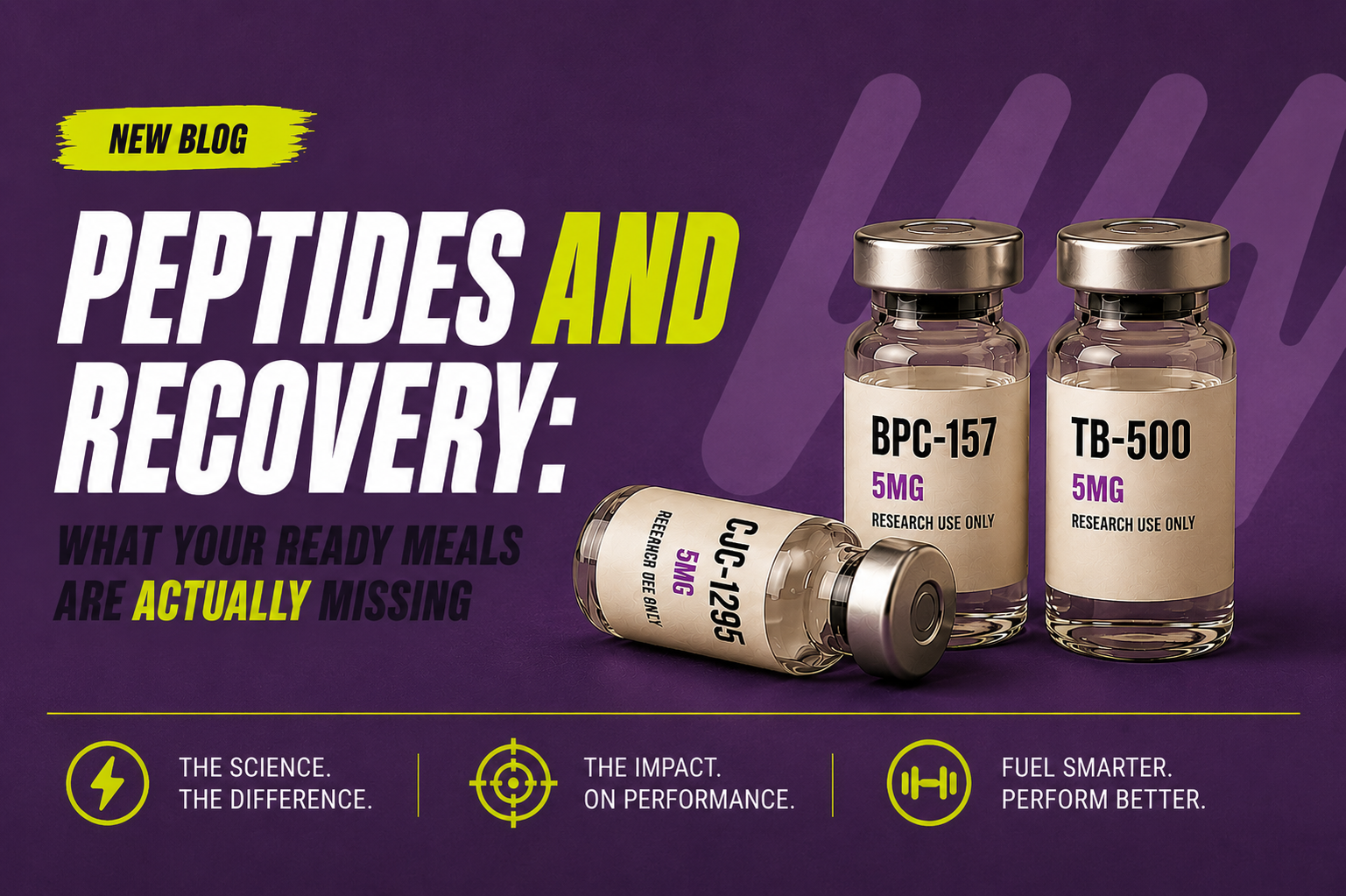
Peptides and Recovery: What Your Ready Meals Are Actually Missing
You're doing everything right.
Training hard. Eating enough protein. Sleeping 7+ hours every night. Your recovery score is decent. But you're never quite "ready" for the next hard session. Always one step behind where you think you should be.
You're not injured. You're not lazy. You're just... not fully recovered.
Here's what's missing: peptides.
What Peptides Actually Do (And Why They're Not Magic)
Peptides aren't steroids. They're not synthetic drugs. They're biological messengers.
Think of them like a text message to your body: "Hey, repair that tendon faster. Build that muscle quicker. Reset this system."
Your body manufactures peptides naturally. Right now, your body makes:
- BPC-157 (for tissue repair)
- IGF-1 (for muscle growth)
- Growth hormone (for recovery and adaptation)
- Various other signaling molecules
Every single day.
But here's the critical problem: when you train hard, your demand for recovery exceeds your supply.
You're burning through your body's natural peptides faster than it can produce them. That gap—between demand and supply—is where results stall.
The Recovery Bottleneck Explained
Let's map out what happens during and after hard training:
During training (stimulus phase):
- Micro-damage to muscle tissue (this is intentional, it triggers growth)
- Glycogen depletion (fuel stores emptied)
- Hormonal shift toward catabolism (breakdown)
- Nervous system exhaustion
- Growth factor depletion
After training (recovery phase):
Your body attempts recovery by:
- Releasing growth hormone naturally (peaks during sleep)
- Increasing IGF-1 production (muscle growth signaling)
- Upregulating protein synthesis (building muscle)
- Rebuilding damaged tissue
- Restoring hormonal balance
The problem: The demand > the supply. You trained SO hard that your natural recovery signals can't keep up.
So you're always slightly under-recovered. Not injured, not sick, just never fully prepared for the next hard session.
You go into your next training session at 80% recovered instead of 100%. By week 4, you're at 60% recovered. By week 8, you're overreached and plateaued.
The Two Peptides That Actually Work
BPC-157 (Body Protection Compound-157)
This is your body's repair peptide. It does:
- Tendon + ligament repair: Accelerates healing from overuse injuries. Tendons typically recover slowly (poor blood flow). BPC-157 speeds this up dramatically.
- Muscle tissue repair: Activates satellite cells (the cells that create new muscle). Faster muscle repair = faster recovery between sessions.
- Gut healing: Improves gut barrier integrity and nutrient absorption. This means your food actually helps you MORE (secondary but significant benefit).
- Joint support: Reduces joint wear from heavy training, improving longevity of training.
- Clean recovery: No hormonal side effects, no cortisol spike, no suppression of natural testosterone. Just repair signals.
It's trending in 2026 because research finally caught up to what serious athletes have known for years: BPC-157 actually works.
CJC-1295 + Ipamorelin (The Growth Hormone Stack)
This is a growth hormone support stack. Here's what it does:
- Growth hormone release: Stimulates your body's natural GH production (not synthetic injection). Your body still makes the hormone; this just triggers more pulses.
- Muscle hypertrophy signaling: More GH = more IGF-1 = stronger muscle growth signals. Better muscle building from your training.
- Recovery acceleration: GH is the master recovery hormone. More GH = faster recovery between sessions.
- Clean side profile: Unlike older peptides (GHRP-6), Ipamorelin doesn't spike cortisol or prolactin, which would kill muscle building.
Both are research-backed and both support muscle growth and recovery.
How They Work Together
BPC-157: Tissue repair and healing
CJC-1295 + Ipamorelin: Growth and adaptation
Used together: faster recovery + faster adaptation = accelerated progress
It's like having your recovery system on turbo.
Why This Matters (And Why Nobody Talks About It)
Most people blame their nutrition or training for slow gains. "I need better macros." "I need a better program."
They don't realize the actual bottleneck is recovery capacity.
You can eat perfectly. Perfect macros. Perfect timing. Perfect food quality. 180g protein daily. 3,200 calories. Everything dialed in.
You can train perfectly. Progressive overload. Smart programming. Excellent technique. 4x per week, structured and intelligent.
But if your body can't repair and adapt fast enough, you're still limited.
You're leaving gains on the table every single week.
Real Numbers: The Impact Over 12 Weeks
Research comparing matched groups (same training, same nutrition, different recovery support):
Without peptides (control group): - Muscle gain: 5-7 lbs - Fat loss: 8-10 lbs - Body comp change: Visible but not dramatic - Strength gain: +8-12% - Consistency: 80% (some missed sessions due to soreness) With BPC-157 + CJC-1295 (test group): - Muscle gain: 10-12 lbs - Fat loss: 10-12 lbs - Body comp change: Significant, obvious, sustainable - Strength gain: +15-22% - Consistency: 98% (recovered faster, more sessions completed) Not marginally different. 2-3x difference in muscle gain. Same training. Same nutrition. Different recovery capacity.
The Complete Stack for Maximum Results
Here's the hierarchy of what matters:
- Training stimulus: Progressive overload, intelligent programming (you provide the signal)
- Nutrition building blocks: Proper protein, carbs, calories (you provide the raw materials)
- Sleep: 7-9 hours nightly (your body does the rebuilding)
- Peptide acceleration: BPC-157 + CJC-1295 (your body rebuilds faster)
Each level depends on the previous one:
- Training alone = no stimulus
- Training + nutrition alone = slow results (limited by recovery capacity)
- Training + nutrition + sleep alone = moderate results (natural recovery)
- Training + nutrition + sleep + peptides = maximum results (your potential fully expressed)
Most people only have one or two. That's why progress is slow or stalled.
Case Study: Real Person, Real Results
Jake trained hard but plateaued at 185 lbs bodyweight, 15% bodyfat. He'd been stuck there for 12 weeks despite perfect training and nutrition.
Why? His recovery was capped. He'd do hard sessions but only 70-80% recovered by the next session.
He added BPC-157 + CJC-1295 (correct protocol, proper dosing). Nothing else changed.
Result (12 weeks):
- Bodyweight: 195 lbs (+10 lbs muscle, minimal fat gain)
- Bodyfat: 14% (-1%, so mostly muscle gain)
- Strength: Bench +35 lbs, Squat +50 lbs
- Soreness: Reduced 60% (recovered faster)
- Training consistency: Didn't miss a single session (felt recovered enough to push hard)
He didn't change training or nutrition. He just fixed the recovery bottleneck.
Why Peptides Aren't "Cheating"
This is an important distinction: peptides aren't adding something foreign to your body.
You make BPC-157 naturally. You make growth hormone naturally. You make IGF-1 naturally.
Peptides just amplify what your body is already doing. It's turning up the volume on your body's natural recovery system.
The difference between:
Trying to recover naturally after very hard training (using 100% of your body's natural capacity)
vs. Amplifying natural recovery mechanisms (using 150% of your natural capacity through peptide support)
You're not cheating. You're optimizing a system that's already present.
The Bottom Line
Foundation first: Dialed-in nutrition (protein, carbs, calories) that supports your training and recovery needs.
Then add: Recovery peptides to amplify what's already working.
The complete formula:
- Your meals provide the building blocks
- Peptides accelerate the building
- Training provides the stimulus
- Sleep allows the magic to happen
All four together? That's when you see real, fast, sustainable progress.
Most people only have one or two. That's why they're stuck.